Home / Tankless conversion
Layton, UT · Conversion
Tank to tankless conversion.What changes when a Layton home moves from a water heater tank to tankless.
A tankless conversion is a small project, not a swap. Gas, vent, and water all change.
- Gas line
- Venting
- Condensate
- Descaling
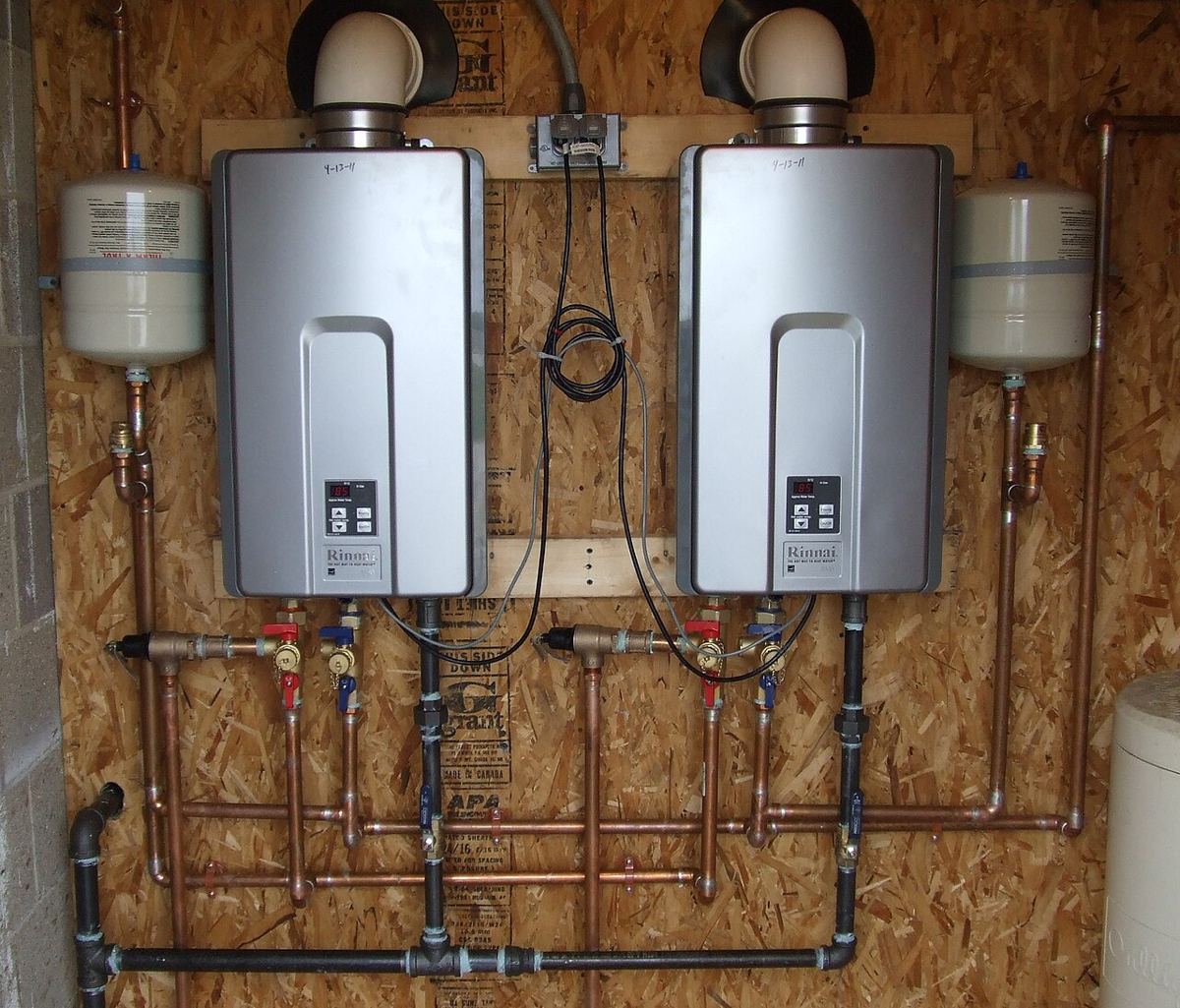
Background: Photo: Mcloward, Wikimedia Commons, CC BY-SA 4.0.

What changes in a tankless conversion.
1. Gas supply
Tank burners are small. Tankless burners are large. The line from the meter, and sometimes the meter itself, has to carry the new load.[1]
2. Venting
Tankless units vent through their own listed pipe, often PVC for condensing units. The old metal flue may stay for the furnace or be capped.
3. Condensate
Condensing tankless units make acidic water. It needs a drain path and often a neutralizer.
4. Water
Isolation valves let the unit be flushed. With water at 10 to 18 grains per gallon,[2] that flush is routine care.
5. Space and power
The unit mounts on a wall and needs a 120-volt outlet for its controls. The old tank's floor space opens up.

Altitude is part of setup too. Layton is about 4,459 feet up.[5] Many gas units list altitude settings in the manual.
Still deciding? See tank vs tankless.
Steps in a Layton tankless conversion.
- Size the unit. Count fixtures that run at once and set a winter rise.[6]
- Check the gas. Measure the run from the meter and the load of every gas appliance.[1]
- Plan the vent. Pick a wall or roof exit that meets the unit's clearances.
- Plan the drain. Condensing units need a condensate path, often with a neutralizer.
- Pull the permit. Layton takes permits and inspection requests online.[3]
- Remove the tank. Drain it, disconnect it, and haul it off.
- Mount and pipe. Add isolation valves for future descaling.
- Set up. Set the altitude option from the manual and the temperature.
- Test. Check gas pressure, combustion, flow, and temperature.
Is a tankless conversion worth it?
Often worth it when
- You plan to stay for years, since tankless can last up to about 20 years[1]
- Back-to-back showers run your tank cold
- You want the floor space back
- The gas meter and line can carry the load, or can be upgraded
Often not worth it when
- You need hot water back today
- The vent route is long or blocked
- The budget points to a like-for-like tank
Neighbors in Kaysville will find a gas sizing upgrade checklist on their city's permit page.[7]
Not sure? Run the fit quiz on tank vs tankless, or start with water heater replacement in Layton.
FAQ
Tankless conversion in Layton: FAQ
Can any Layton home switch from a tank to tankless?
Why does tankless need a bigger gas line?
What happens to the old vent?
Is a permit needed for a tankless conversion?
How long does a tankless conversion take?
Can the tankless unit go in the garage?
Will a conversion help with hard water?
Ready to go tankless?
Send your current tank details. Get a free conversion quote.
Get your free quoteKeep reading
Sources
- U.S. DOE Building America: Measure Guideline, Transitioning to a Tankless Water Heater (PDF)
- Weber Basin Water Conservancy District: 2024 Consumer Confidence Report (PDF)
- Layton City: Building Division, Permits and Inspections
- ENERGY STAR Technical Bulletin: Demand Water Heaters (PDF)
- Wikipedia: Layton, Utah (elevation)
- PNNL / DOE Building America Solution Center: Gas-Fired Tankless Water Heaters
- Kaysville City: Building Permits